
Introduction to Stock Analysis Stock analysis is the systematic process of examining a company’s financial performance, operational efficiency, industry position, and stock price behavior to determine the potential value and risk associated with investing in its shares. The objective of stock analysis is to estimate the intrinsic value of a stock and compare it with its market price. If the intrinsic value is higher than the current market price, the stock may be considered undervalued, whereas if the intrinsic value is lower than the market price, the stock may be considered overvalued. Stock analysis combines multiple disciplines such as financial statement analysis, economic analysis, statistical evaluation, and market behavior study to understand how a company performs and how its stock price may behave in the future. For educational platforms like SafeInvestment.ai, stock analysis serves as a foundation for understanding how financial markets operate and how investors evaluate companies before making investment decisions.
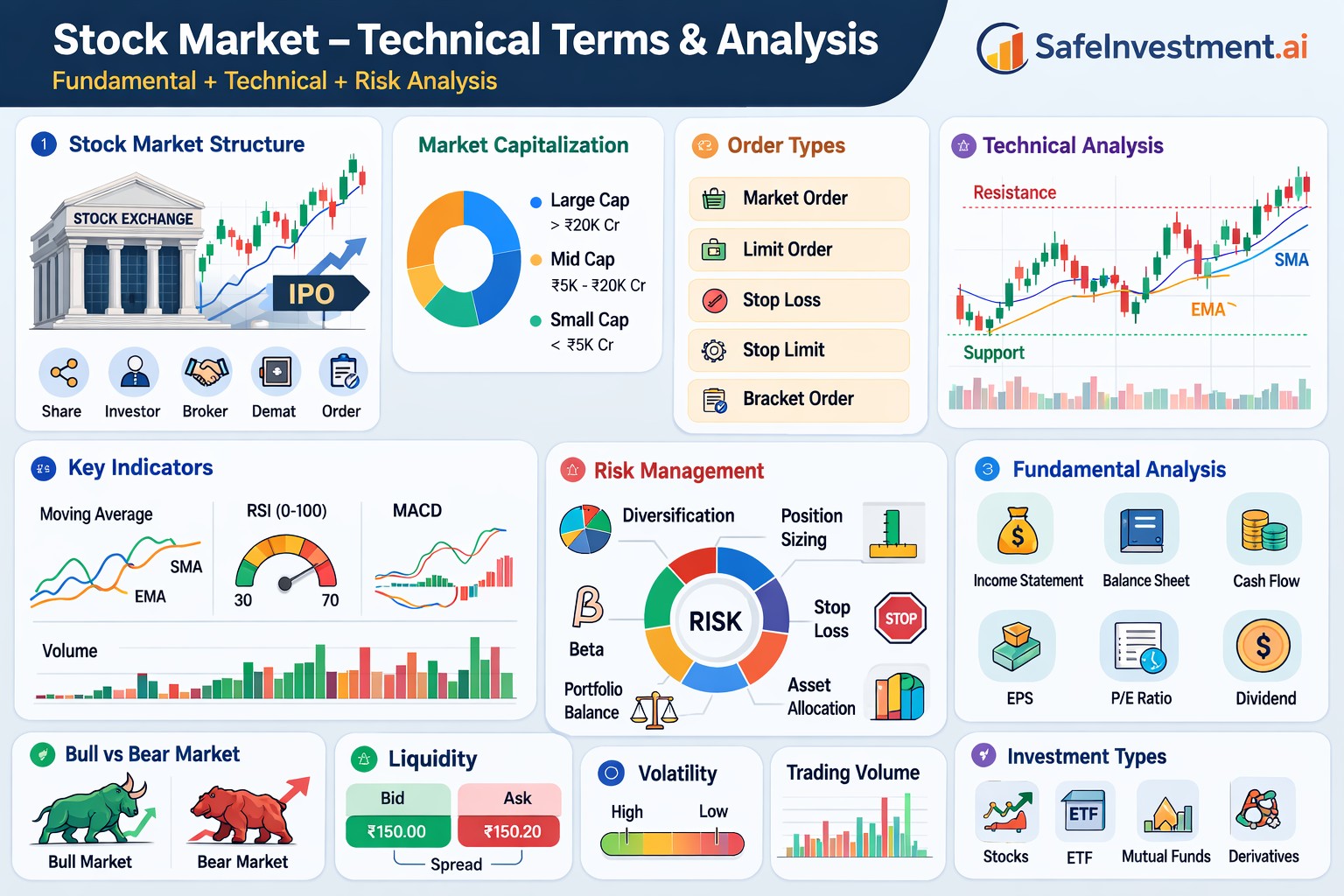
A stock represents fractional ownership in a corporation. When a company issues shares, it divides ownership of the company into small units that investors can purchase.
Stock ownership provides investors with:
Voting rights in corporate decisions
Participation in company profits through dividends
Potential capital appreciation if the stock price increases
From an analytical perspective, stocks represent claims on future corporate earnings and assets.
Example:
If a company has issued 10 million shares and an investor owns 100,000 shares, the investor owns 1% of the company.
Market capitalization measures the total market value of a company's equity.
Formula:
Market Capitalization = Share Price × Total Outstanding Shares
Market capitalization helps investors classify companies into different categories.
Large-cap companies have very high market capitalization and usually represent established businesses with stable earnings.
Characteristics:
Lower risk
Stable growth
Consistent dividends
Mid-cap companies are medium-sized firms with moderate growth potential.
Characteristics:
Higher growth potential than large-cap companies
Moderate risk
Small-cap companies are smaller firms with high growth potential but also higher risk.
Characteristics:
Higher volatility
Potential for rapid expansion
Liquidity refers to the ease with which a security can be bought or sold in the market without significantly affecting its price.
High liquidity ensures:
Faster transactions
Narrow bid-ask spreads
Lower transaction costs
Example:
Stocks of large companies usually have high liquidity because many investors actively trade them.
Low liquidity stocks may experience larger price fluctuations due to limited buyers and sellers.
Volatility measures the degree of variation in stock price movements over time.
In financial analysis, volatility is often measured using standard deviation or variance of returns.
High volatility indicates:
Large price fluctuations
Higher risk
Potential for higher returns
Low volatility indicates:
Stable price movements
Lower risk
Example:
A stock moving between Rs 100 and Rs110 shows lower volatility compared to a stock moving between Rs100 and Rs160.
The bid price represents the highest price buyers are willing to pay for a stock.
The ask price represents the lowest price sellers are willing to accept.
The difference between them is known as the bid-ask spread.
Formula:
Bid-Ask Spread = Ask Price − Bid Price
Example:
Bid price = Rs150
Ask price = Rs152
Spread = Rs2
A narrow spread usually indicates high liquidity and active trading.
Trading volume represents the total number of shares traded within a specific time period.
Volume provides important insights into market activity.
High volume indicates:
Strong investor participation
High market interest
Low volume indicates limited trading activity.
Example:
If 2 million shares of a company are traded in one day, the trading volume is 2 million.
A bull market is characterized by sustained increases in stock prices and strong investor confidence.
Economic conditions during a bull market often include:
Strong economic growth
Increasing corporate profits
Rising investor optimism
Bull markets often lead to higher investment activity and economic expansion.
A bear market occurs when stock prices decline significantly for an extended period.
Typical characteristics include:
Investor pessimism
Economic slowdown
Falling corporate earnings
Bear markets often result from economic crises, financial instability, or major geopolitical events.
Support and resistance are important technical analysis concepts used to identify price levels where buying or selling pressure emerges.
Support represents a price level where buying demand is strong enough to prevent further price decline.
Example:
If a stock repeatedly stops falling near ?500, this level acts as support.
Resistance represents a price level where selling pressure prevents the price from rising further.
Example:
If a stock repeatedly fails to cross Rs 600, this level becomes resistance.
Moving averages help smooth out short-term price fluctuations and reveal long-term trends.
Two common types include:
SMA calculates the average stock price over a specified number of periods.
Example:
A 50-day SMA represents the average closing price over the last 50 trading days.
EMA gives greater weight to recent price data, making it more responsive to new market information.
EMA is often used in short-term trading strategies.
RSI is a momentum oscillator that measures the speed and magnitude of price movements.
RSI ranges between 0 and 100.
Interpretation:
RSI above 70 → Overbought condition
RSI below 30 → Oversold condition
Example:
If RSI = 80, the stock may be considered overbought, indicating potential price correction.
MACD (Moving Average Convergence Divergence) measures trend strength and momentum changes.
MACD consists of:
MACD Line
Signal Line
Histogram
Trading signals occur when the MACD line crosses the signal line.
Example:
MACD crossing above the signal line may indicate a bullish trend.
A dividend is a portion of company profits distributed to shareholders.
Dividends are typically paid regularly to investors as a reward for holding shares.
Example:
If a company declares a dividend of ?5 per share and an investor owns 200 shares, the investor receives ?1,000.
A portfolio refers to the collection of financial assets owned by an investor.
Assets may include:
Stocks
Bonds
Mutual funds
ETFs
Real estate
Portfolio management focuses on optimizing returns while minimizing risk.
Diversification is the investment strategy of spreading investments across different assets to reduce overall risk.
By diversifying investments, investors can reduce the impact of poor performance in any single asset.
Example:
Instead of investing entirely in technology stocks, an investor may allocate funds across:
Technology sector
Banking sector
Healthcare sector
The information provided on SafeInvestment.ai is for educational and informational purposes only. The content published on this website is intended to help readers understand financial concepts such as investment analysis, stock market fundamentals, portfolio management, and financial planning.
SafeInvestment.ai does not provide financial, investment, legal, or tax advice. The information presented should not be interpreted as a recommendation to buy, sell, or hold any financial security, investment product, or financial instrument.
Financial markets involve risk, and investment decisions should be made carefully after conducting independent research or consulting with a qualified financial advisor or professional.
While efforts are made to ensure that the information provided on this website is accurate and up to date, SafeInvestment.ai makes no guarantees regarding the completeness, reliability, or accuracy of the content.
SafeInvestment.ai and its authors shall not be held responsible for any financial losses, investment decisions, or actions taken based on the information provided on this website.
By using this website, you acknowledge that you are responsible for your own financial decisions and agree to use the information for educational purposes only.