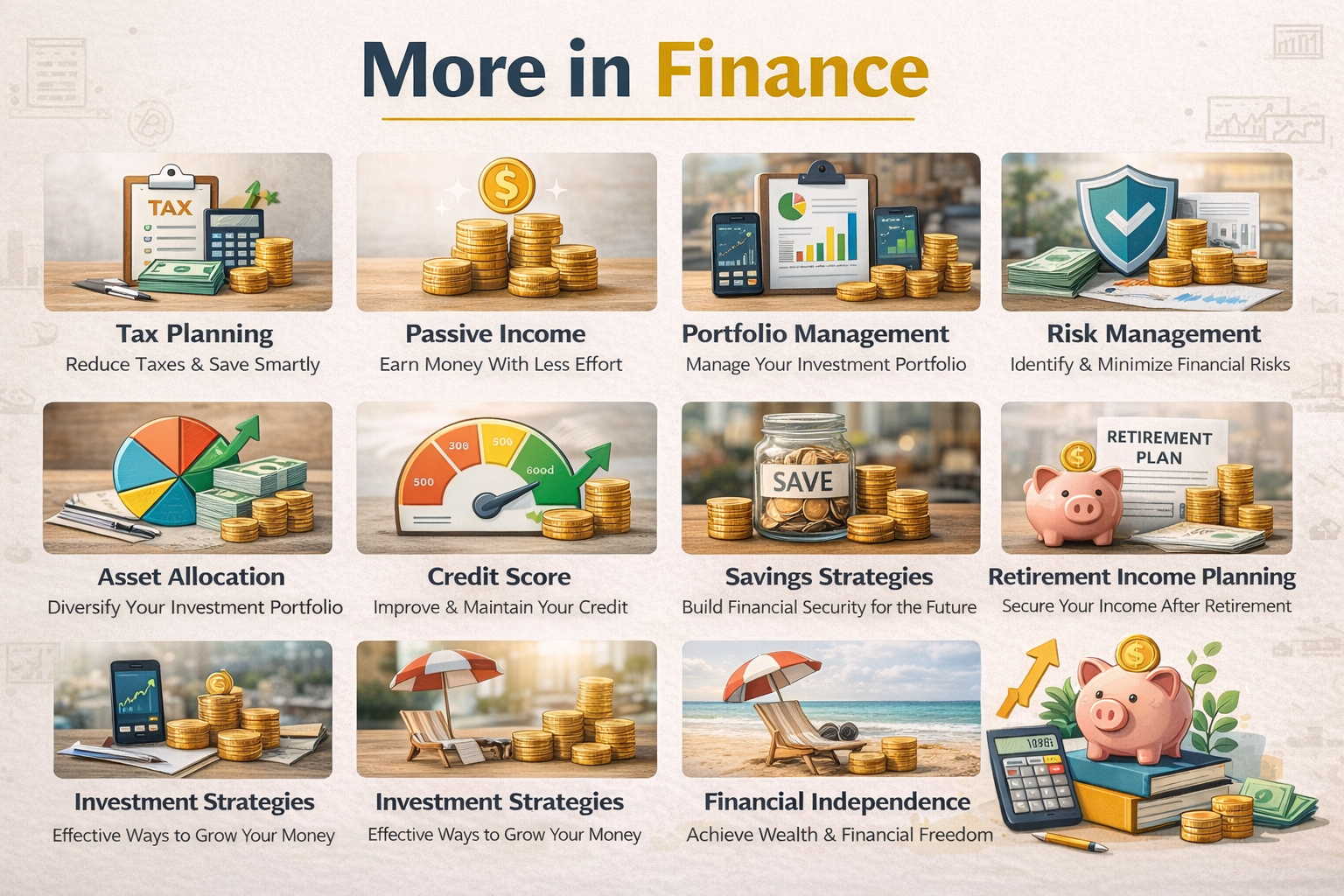
The More in Finance section on SafeInvestment provides additional insights into important financial topics such as tax planning, portfolio management, passive income, credit score improvement, asset allocation, savings strategies, and financial independence. These topics help individuals develop a deeper understanding of how the financial system works and how different financial tools can support long-term wealth creation. Learning about these areas allows individuals to make better financial decisions, manage risks effectively, and build a strong financial future. By understanding advanced financial concepts and practical strategies, readers can improve their financial literacy and strengthen their overall financial planning.
Mutual funds are popular investment vehicles that allow individuals to invest in diversified portfolios managed by professional fund managers. They pool money from multiple investors and invest it in various financial instruments such as stocks, bonds, and other securities.
Mutual funds are suitable for investors who want diversification and professional management without directly managing individual securities. Investors can choose from different types of mutual funds, including equity funds, debt funds, hybrid funds, and index funds depending on their risk tolerance and financial goals.
Systematic Investment Plans (SIP) enable investors to invest small amounts regularly, making mutual funds accessible even for beginner investors. Over time, disciplined investing in mutual funds can help individuals build long-term wealth and achieve financial goals.
The stock market provides investors with an opportunity to invest in publicly traded companies and participate in economic growth. By purchasing shares, investors become partial owners of companies and may benefit from capital appreciation and dividend income.
Stock market investing requires understanding company fundamentals, market trends, and risk management strategies. Long-term investing in strong businesses can help investors build significant wealth over time.
SafeInvestment provides educational insights to help readers understand stock market basics, investment strategies, and market analysis techniques.
Real estate is considered a stable long-term investment that can generate both rental income and capital appreciation. Investing in property allows individuals to diversify their portfolios while building tangible assets.
Real estate investments include residential properties, commercial properties, land investments, and real estate investment trusts (REITs). Property markets often move differently from financial markets, making real estate a valuable diversification tool for investors.
Understanding property markets, financing options, and long-term investment strategies is essential for successful real estate investing.
Government financial schemes are designed to promote savings, financial inclusion, and social security. These programs provide financial support, insurance protection, pension benefits, and savings opportunities for individuals.
Many schemes focus on encouraging disciplined savings and long-term financial security. Government initiatives often target specific groups such as low-income households, senior citizens, students, and entrepreneurs.
Understanding these schemes helps individuals take advantage of available benefits and improve financial stability.
Exchange Traded Funds (ETFs) are investment funds that trade on stock exchanges similar to individual stocks. ETFs typically track an index, sector, commodity, or group of assets and provide investors with diversified exposure to a particular market.
ETFs are popular because they offer diversification, transparency, and relatively low management costs compared to traditional mutual funds. Investors can buy or sell ETF units during market hours, making them flexible investment options.
ETFs are commonly used for index investing and portfolio diversification.
Financial planning is the process of organizing income, expenses, savings, and investments to achieve financial goals. It helps individuals create a roadmap for managing their finances effectively.
A comprehensive financial plan includes budgeting, saving, investment planning, insurance protection, tax planning, and retirement preparation. Proper financial planning helps individuals build wealth while managing financial risks.
By following structured financial planning strategies, individuals can achieve long-term financial independence.
Wealth management focuses on protecting, growing, and managing financial assets through strategic financial planning and investment management. It combines various financial services such as investment advisory, tax planning, and risk management.
Effective wealth management strategies include asset allocation, diversification, and long-term financial planning. These strategies help individuals preserve their wealth while achieving sustainable financial growth.
Wealth management plays an important role in financial security and intergenerational wealth preservation.
An emergency fund is a financial reserve set aside to cover unexpected expenses such as medical emergencies, job loss, or urgent repairs. Maintaining an emergency fund helps individuals manage financial uncertainty without relying on debt.
Financial experts generally recommend keeping emergency savings equivalent to several months of living expenses.
Building an emergency fund is an essential step in personal financial planning because it provides financial security and peace of mind during unforeseen situations.
April 1, 2026
March 30, 2026
July 26, 2025