By Safe Investment September 13, 2026
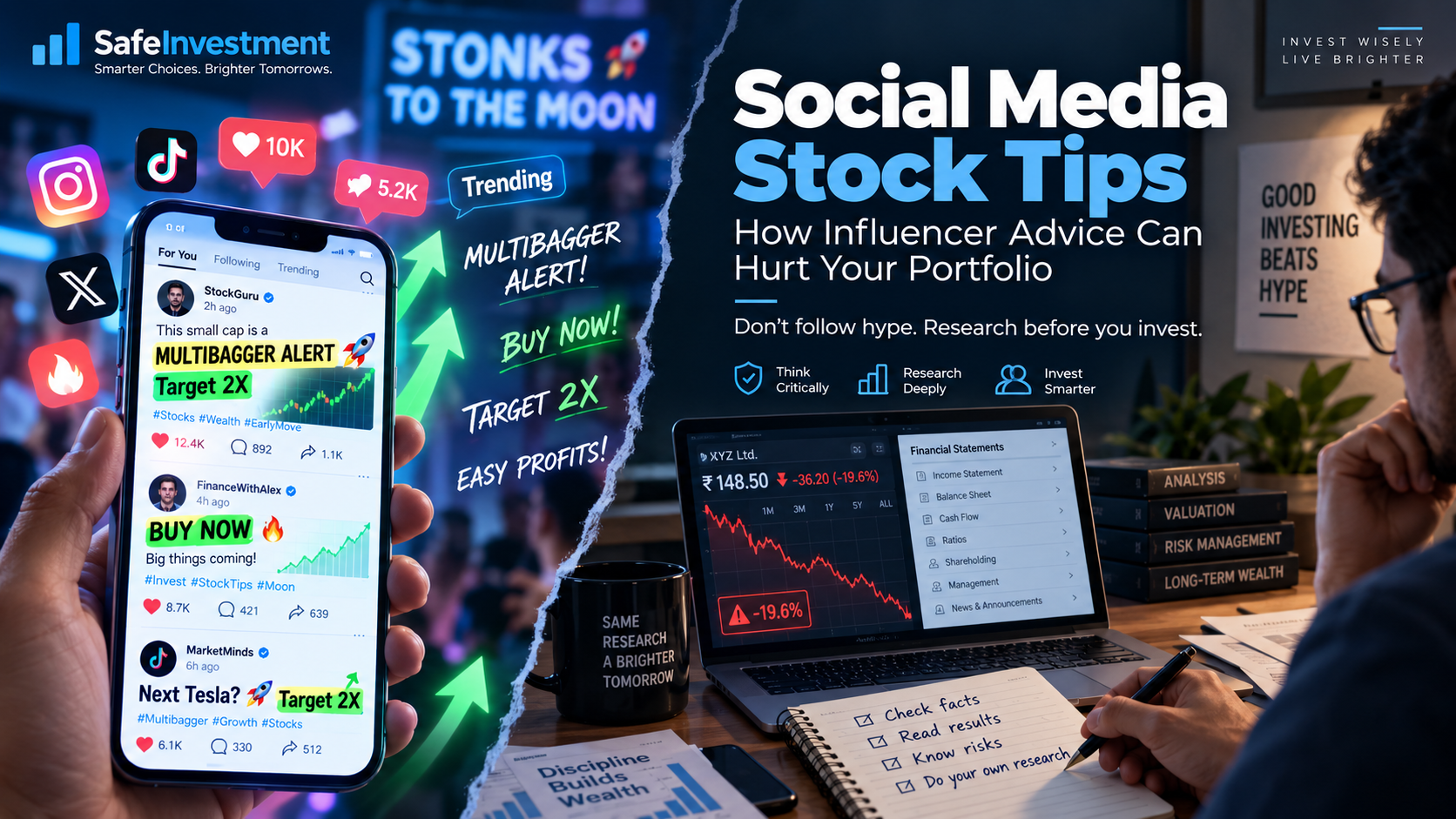
You are scrolling through YouTube or Instagram when a video appears:
“This stock could double in the next six months.”
Later, you see another creator discussing the same company. Then the stock appears in a Telegram or WhatsApp group.
The price is already rising.
And suddenly you start thinking:
“What if I miss the opportunity?”
This is how many investors today discover stocks. There is nothing wrong with finding investment ideas on social media. The problem begins when an online recommendation becomes the only reason for buying a stock.
At SafeInvestment, we believe an investment idea should start with curiosity—but end with proper research.
Social media rewards attention.
A video titled:
“Understanding a Company’s Cash Flow”
may receive less attention than:
“This Rs 100 Stock Could Become Rs 500!”
The second headline sounds exciting, but excitement does not make a stock a good investment.
A creator may speak confidently, show charts and give ambitious target prices. But before investing your money, you still need to understand the business behind the stock.
Remember:
Views are not research.
Followers are not fundamentals.
Confidence is not a guarantee.
Fear of missing out, or FOMO, is one of the biggest risks of following social media stock tips.
Suppose a stock is trading at Rs100 and someone predicts it will reach Rs 200.
You don't buy immediately.
A few days later, it reaches Rs115. More creators start discussing it and people online are posting profits.
Now your thinking changes from:
“Is this company worth investing in?”
to:
“What if it reaches Rs 200 without me?”
That is when investors can end up buying based on emotion rather than analysis.
Before buying any stock, investors should look beyond the online excitement.
Ask basic questions:
A stock may be trending online and still be a poor investment at the current price.
Even if an influencer genuinely likes a stock, that does not automatically mean it is suitable for you.
A high-risk stock may represent only 1% of an influencer's portfolio, while a follower may put 20% or 30% of their savings into the same company.
The influencer usually does not know your:
income, liabilities, investment goals, time horizon or ability to handle losses.
The same stock can therefore carry very different risks for different investors.
It is also worth asking whether the creator has a financial interest in the stock being discussed.
They may already own shares. They may have sponsorships, paid memberships, subscriptions or other commercial relationships.
This does not automatically mean the information is unreliable.
But investors should be aware of possible conflicts of interest before acting on any recommendation.
Be especially careful when lesser-known or low-volume stocks suddenly become popular across multiple social media accounts.
Large profit screenshots can be very convincing.
But a screenshot rarely shows the entire story.
You don't know how much money was invested, whether leverage was used, how many earlier trades lost money or whether the profit was actually booked.
Social media usually shows the winners.
The losses are much less visible.
If someone uses phrases such as:
“Guaranteed profit”
“Sure-shot stock”
“No-loss trade”
“100% return guaranteed”
treat them as warning signs.
The stock market always involves uncertainty. Even experienced investors can make wrong decisions.
No online creator can remove investment risk simply by sounding confident.
This is one of the most important questions.
Suppose you buy a stock because an influencer recommends it.
The stock falls 25%.
Should you sell, hold or buy more?
If you never researched the company yourself, you may have no idea.
When someone else gives you the reason to buy, you may also become dependent on that person to tell you when to sell.
That is why understanding your own investment thesis matters.
Social media can still be extremely useful.
You can discover companies, learn financial concepts and hear different views from experienced investors.
But a better approach is:
Use social media to discover a stock. Use research to decide whether to buy it.
Before investing, check the company's financial statements, debt, cash flow, management, business model, competition, valuation and risks.
Then ask yourself:
If the answer is no, you probably need more research.
Social media has made investment ideas available to everyone within seconds.
But faster access to stock tips does not automatically lead to better investment decisions.
A viral recommendation can be a useful starting point, but it should never replace independent research.
The next time someone says:
“Buy this stock before it's too late,”
don't rush to your trading app.
First ask:
“Why should I own this company?”
At SafeInvestment, we believe good investing is not about following the loudest voice online. It is about understanding where your money is going, knowing the risks and making decisions that fit your own financial goals.
Discover ideas. Do your research. Invest with understanding.
This article by SafeInvestment is for educational and informational purposes only. It should not be considered investment advice or a recommendation to buy or sell any security. Investors should conduct their own research and, where appropriate, consult a qualified SEBI-registered professional before making investment decisions.
Your email address will not be published. Required fields are marked *